Friday, November 16, 2018
HISTORIC PARADE
Speech by J. V. Stalin at the Red Army Parade
on Red Square, Moscow
November 7, 1941
COMRADES, men of the Red Army and Red Navy, commanders and political instructors, working men and working women, collective farmers-men and women, workers in the intellectual professions, brothers and sisters in the rear of our enemy who have temporarily fallen under the yoke of the German brigands, and our valiant men and women guerillas who are destroying the rear of the German invaders!
On behalf of the Soviet Government and our Bolshevik Party I am greeting you and congratulating you on the twenty-fourth anniversary of the Great October Socialist Revolution.
Comrades, it is in strenuous circumstances that we are to-day celebrating the twenty-fourth anniversary of the October Revolution. The perfidious attack of the German brigands and the war which has been forced upon us have created a threat to our country. We have temporarily lost a number of regions, the enemy has appeared at the gates of Leningrad and Moscow. The enemy reckoned that after the very first blow our army would be dispersed, and our country would be forced to her knees. But the enemy gravely miscalculated. In spite of temporary reverses, our Army and Navy are heroically repulsing the enemy’s attacks along the entire front and inflicting heavy losses upon him, while our country—our entire country—has organized itself into one fighting camp in order, together with our Army and our Navy, to encompass the rout of the German invaders.
There were times when our country was in a still more difficult position. Remember the year 1918, when we celebrated the first anniversary of the October Revolution. Three-quarters of our country was at that time in the hands of foreign interventionists. The Ukraine, the Caucasus, Central Asia, the Urals, Siberia and the Far East were temporarily lost to us. We had no allies, we had no Red Army—we had only just begun to create it; there was a shortage of food, of armaments, of clothing for the Army. Fourteen states were pressing against our country. But we did not become despondent, we did not lose heart. In the fire of war we forged the Red Army and converted our country into a military camp. The spirit of the great Lenin animated us at that time for the war against the interventionists. And what happened? We routed the interventionists, recovered all our lost territory, and achieved victory.
To-day the position of our country is far better than twenty-three years ago. Our country is now many times richer than it was twenty-three years ago as regards industry, food and raw materials. We now have allies, who together with us are maintaining a united front against the German invaders. We now enjoy the sympathy and support of all the nations of Europe who have fallen under the yoke of Hitler’s tyranny. We now have a splendid Army and a splendid Navy, who are defending with their lives the liberty and independence of our country. We experience no serious shortage of either food, or armaments or army clothing. Our entire country, all the peoples of our country, support our Army and our Navy, helping them to smash the invading hordes of German fascists. Our reserves of man-power are inexhaustible. The spirit of the great Lenin and his victorious banner animate us now in this patriotic war just as they did twenty-three years ago.
Can there be any doubt that we can, and are bound to, defeat the German invaders?
The enemy is not so strong as some frightened little intellectuals picture him. The devil is not so terrible as he is painted. Who can deny that our Red Army has more than once put the vaunted German troops to panic flight? If one judges, not by the boastful assertions of the German propagandists, but by the actual position of Germany, it will not be difficult to understand that the German-fascist invaders are facing disaster. Hunger and impoverishment reign in Germany to-day; in four months of war Germany has lost four and a half million men; Germany is bleeding, her reserves of man-power are giving out, the spirit of indignation is spreading not only among the peoples of Europe who have fallen under the yoke of the German invaders but also among the German people themselves, who see no end to war. The German invaders are straining their last efforts. There is no doubt that Germany cannot sustain such a strain for long. Another few months, another half-year, perhaps another year, and Hitlerite Germany must burst under the pressure of her crimes.
Comrades, men of the Red Army and Red Navy, commanders and political instructors, men and women guerillas, the whole world is looking to you as the force capable of destroying the plundering hordes of German invaders. The enslaved peoples of Europe who have fallen under the yoke of the German invaders look to you as their liberators. A great liberating mission has fallen to your lot. Be worthy of this mission! The war you are waging is a war of liberation, a just war. Let the manly images of our great ancestors—Alexander Nevsky, Dimitry Donskoy, Kuzma Minin, Dimitry Pozharsky, Alexander Suvorov and Mikhail Kutuzov—inspire you in this war! May the victorious banner of the great Lenin be your lodestar!
For the complete destruction of the German invaders!
Death to the German invaders!
Long live our glorious Motherland, her liberty and her independence!
Under the banner of Lenin, forward to victory!
We will be firm on the chosen path
Dear friends, party comrades! The Central Committee of the AUCPB congratulates ALL YOU on the 27th anniversary of the creation of our Leninist-Stalinist party, the All-Union Communist Party of Bolsheviks.
We were the first at the height of the counter-revolution who raised the banner of Bolshevism. We revived Bolshevism, which the revisionist CPSU refused after Stalin’s death. This led to the victory of the counter-revolution, the collapse of the USSR and the formation of bourgeois states on its territory.
Over the years of counter-revolution, the industrial potential of the country has been destroyed, agriculture has collapsed, food security has been lost, the defense power has been undermined. Nothing worthwhile has been created in the field of culture, art or literature.
There is only one choice: “Either we will endlessly endure, dropping to the position of wordless slaves, or we will rise to a common struggle for our common demands” (J.V. Stalin).
Our main work today is Bolshevik agitation and propaganda among the masses.
“If the party succeeds in drawing into the struggle not only its members, if it succeeds in shaking up non-partisans, this is already the beginning of the conquest of the masses” (V.I. Lenin).
In our 27 years we have done something that no one, except us, had previously believed that it was possible to do at all. With our uncompromising struggle against anti-Stalinism, we turned public opinion in the direction of J.V. Stalin, denoting anti-Stalin hysteria (anti-Stalinism) and attacks on Stalin’s name and cause with a Trojan horse in the international communist movement, and to a certain extent changed the situation in the world communist movement. After all, anti-Stalinism was developed by the secret services of the West and used as a battering ram for the collapse of the USSR and historical amnesia of the Soviet people.
Our twenty-seven year old struggle is a constant battle along the way. We, the AUCPB, work for the future, for socialism. So let us be firm and adamant in our beliefs and aspirations in achieving the goal.
100 years since the November revolution in Germany
This autumn marks the 100th anniversary of the November Revolution in Germany, which led to the overthrow of the monarchy and the establishment of a republic.
It is believed that the November Revolution, beginning in November 1918, ended in the summer of 1919. However, the revolutionary battles continued in Germany until the autumn of 1923, culminating in the Hamburg Uprising (whose 95th anniversary we celebrate in October).
The revolution began with an uprising of sailors in the city of Kiel. By early November, it was already clear that Germany was losing the First World War. But the high command decided to send a navy to the final battle in order to wrest acceptable conditions of peace from the Entente. Not wanting a meaningless death, the sailors spoke on November 3, the workers supported them. The uprising spread to other areas of Germany. On November 9, a general strike began in Berlin, growing into an uprising. Emperor Wilhelm II fled to Holland.
The further development of the situation, however, did not go beyond the framework of the bourgeois-democratic revolution. The workers of Germany were under the influence of the Social Democrats, who by the beginning of the revolution were divided into two parties: the Social Democratic Party of Germany (SPD) and the Independent Social Democratic Party of Germany (NSPD). The first occupied frankly right positions. The latter, standing on “centrist” positions, were maneuvering and, at the most crucial moment, moving in agreement with the bourgeoisie.
Karl Liebknecht and Rosa Luxemburg
The revolutionary Marxists created the Spartak alliance during the war. Spartacists were led by Karl Liebknecht and Rosa Luxemburg. On December 30, 1918, the Spartacists united with other radical left groups and created the German Communist Party (KKE).
After the overthrow of the monarchy in the country, a government was formed, in which the right-wing Social Democrats dominated. At the same time, the Soviets began to emerge - the authorities of the working class. However, due to the fact that the workers were under the influence of the Social Democrats, the Soviets did not fight for full power in the country.
Certain mistakes were made by the German Communists. Thus, the Communists did not put forward any slogans and programs that would attract the German peasantry to the side of the revolution. It is known that R. Luxemburg dogmatically criticized the Russian Bolsheviks for transferring land from the landlords to the peasants. In her opinion, this state should immediately create state-collective farms. However, the course of history showed the correctness of the Bolsheviks: in Russia, the working peasantry supported the socialist revolution, while in Germany it was left aside. The revolution in Germany was raging in large cities, without affecting the rural hinterland and its inhabitants.
Thus, in Germany there was no slogan either “power to the Soviets” or “land to the peasants”, and peace — a difficult peace as a result of defeat in the war — had already come.
The peak of the revolutionary battles were the events of January 5 - 12, 1919. The reason for them was, by decision of the government, the resignation of an independent social democrat from the post of chief of the Berlin police. The workers — communists and left-wing Social Democrats — came out in protest demonstrations that escalated into an uprising: the demonstrators began to seize important buildings in Berlin. But the workers were not armed, and the army did not support the rebels. The counterrevolution introduced its armed gangs into the city, the Freikor, formed mainly of reactionary-minded soldiers and officers. The uprising was drowned in blood. On January 15, Karl Liebknecht and Rosa Luxemburg were captured by counter-revolutionaries and killed.
After that, the revolutionary struggle broke out in other cities. The most striking event of the spring of 1919 was the struggle of the Bavarian Soviet Republic, which existed from April 13 to May 1. The region of Bavaria became the only region where the Soviets went beyond the "local issues", and a workers' government was formed. Since April 13, it was headed by a communist Eugene Levin. The Bavarian Soviet Republic was crushed by counterrevolutionary gangs, Levin was killed.
Among the counterrevolutionaries was, and then still unknown to, the corporal Hitler.
Attempts to establish the Soviet republics were in other cities and regions - in Bremen, in Alsace and others.
A revolutionary upswing was observed in the spring of 1920 in the mining district of the Ruhr. In response to an attempt by the anti-republic insurgency, the workers formed the Ruhr Red Army. But in the battles against the army and the "Fraykor" poorly trained workers were defeated.
In March 1921, the clashes took place in the region of Central Germany - Saxony. Workers' speeches began after the police began to arrest the Communists. Disturbances escalated into armed clashes, but again poorly trained rebels could not successfully confront government forces.
A new upsurge of the fight occurred by October 1923. In the regions of Saxony and Thuringia, governments were formed with the participation of left-wing social democrats and communists. The workers armed themselves and created combat detachments, preparing for a fight with the counter-revolution. The central government was frightened that the trend would spread to other areas: in order to prevent socialist changes, troops were transferred to Saxony and Thuringia.
The Communist Party of Germany then headed for an armed uprising throughout the country. However, since 1921, right-wing opportunists led by Heinrich Brandler began to play a leading role in the leadership of the Communist Party. Brandler overturned the earlier decision on the uprising.
The fact that the uprising was canceled, was unknown to the Communists of Hamburg. On the morning of October 23, 1923, the revolutionary workers of Hamburg and its outskirts, under the leadership of their leader Ernst Thalmann, began to seize police stations. The city was covered with barricades. The government threw troops and police against the rebels.
The uprising, limited to the city of Hamburg and its outskirts, without support in other areas was doomed to defeat. Seeing that the Hamburg proletariat was fighting alone, Telman gave the order to stop the uprising, the workers left the barricades.
After separate clashes, left-wing governments in Saxony and Thuringia were dispersed. The Communist Party of Germany was officially banned.
The Hamburg Uprising of October 1923 ended the period of revolutionary battles that took place in Germany from November 1918. Unlike Russia, where the Bolshevik party was, Germany met its anti-monarchist revolution without a party that could lead the proletariat to victory. This led to the defeat of the revolutionary socialist forces.
Beginning in 1923, after the First World War, in general, economic stabilization began in Western Europe. In such conditions, the revolutionary struggle began to decline.
In Germany, the regime of the so-called “Weimar Republic” strengthened, the characteristic feature of which was the power of the right-wing Social Democrats. As history has shown, the "Weimar Republic" turned out to be a "transitional period" - in the period between the two world wars - to the fascist dictatorship.
In 1918 - 1923, Europe had a chance to go the other way. It would be realized in case of victory of the revolutionary forces in Germany. But due to objective and subjective reasons for the development of the situation, this chance was not realized.
Dar Vetrov
CONGRATULATIONS!
Dear comrades! Members of the AUCPB, VGB, our friends and adherents in Russia and abroad! We congratulate ALL YOU on the 101st anniversary of the Great October Socialist Revolution, which was accomplished under the leadership of the working class of Russia and its allies led by the brilliant leaders Lenin and Stalin under the banner of Marxism-Leninism, Bolshevism!
For the first time in world history, the Great October Socialist Revolution severed the age-old chains of oppression and exploitation, freed the working people from poverty, social inequality, spiritual enslavement and brought our Motherland to the advanced positions of human civilization - to socialism.
It was a world historical breakthrough from the prehistory of humanity into the future of our beautiful planet Earth.
Not only our homeland - the USSR, the whole world was transformed as a result of the accomplishment of the Great October Revolution. Socialism breached the world imperialist system and strode victoriously throughout the world, causing furious fear among our enemies, joy and hope among our friends, among the oppressed and dispossessed. The victory of socialism in our country inspired and inspires all sincere and honest fighters in their difficult struggle for the bright future of mankind, for the best life of working people.
We wish ALL of you good health, courage in our common struggle for socialism, for the revival of our great Motherland - the USSR! We wish ALL of YOU the unity of our ranks in the positions of Marxism-Leninism that are the only faithful and verified in the fire of the Great October Revolution and the socialist revolutions that followed it. The truth is on our side and therefore Victory will be ours.
CC AUCPB
Friday, November 9, 2018
Most support the installation of the monument to J.V. Stalin
In Novosibirsk, public discussions on the installation of the monument to J.V. Stalin in the city.
Public discussions were held on the Internet from 9 to 29 October. Three projects for the installation of the monument to J.V. Stalin: near the House of Officers, near the stele "Bayonet" and in the Efremov Square.
The results are published on the official website of the City Hall https://novo-sibirsk.ru/upload/iblock/812/protokol-_-1_stalin.pdf
During the discussion 243 proposals, opinions and recommendations were received.
For the installation of the monument were made 155 public comments. 137 participants proposed to erect a monument to Stalin near the House of Officers, 4 participants proposed to establish a bust next to the stele "Bayonets", 2 - in the Efremov Square. Without the proposal of a specific site for the installation of the monument, 12 opinions were received.
Thus, the installation of the monument J.V. Stalin was supported in the city by two thirds of the participants in public discussions.
As follows from the public comment protocol published on the website of the City Hall, “supporters of the installation of the monument consider that it is necessary to perpetuate this man’s undeniable achievements (the creation of a socialist state, economic reforms, improvement of the industrial level of the country and the creation of nuclear weapons, victory in the Great Patriotic War, restoration of the country after the war), consider it a restoration of justice for the demolition of monuments on the orders of Khrushchev, consider Stalin an important historical figure, consider the installation of the monument part of the patriotic education of the younger generations. Some participants in the discussion indicate that their relatives took part in the Great Patriotic War under the leadership of Stalin.”
According to the available information, the meeting of the artistic council of the city hall, at which the proposed projects for the installation of the monument to J.V. Stalin in the city, will be held on November 9.
Recall that a public opinion poll in Novosibirsk, conducted in March 2017 by the analytical agency “Image Factor” (1020 respondents aged 18 years and older) showed that 49.1% of the citizens have a positive attitude to J.V. Stalin (negatively - 20%). 42.1% of Novosibirsk citizens consider Stalin to be a man who made a decisive contribution to the defeat of fascism, 35.8% - the leader who made the USSR a world power, 30.6% - a major political and statesman on a global scale. 34.3% of the population (several hundred thousand) support the installation in Novosibirsk of the monument to J.V. Stalin, as the Supreme Commander of the period of the Great Patriotic War of 1941 - 45.
A.V. Denisyuk
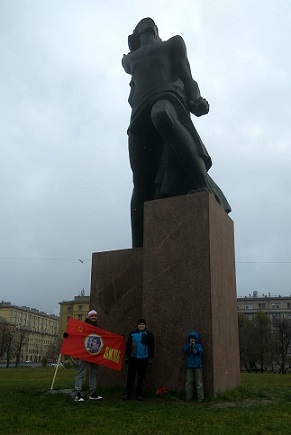
Laying flowers on the Day of the 100th anniversary of the formation of the Komsomol in Leningrad
On October 29, on the Day of the 100th anniversary of the formation of the Komsomol, the Leningrad group of the youth organization of the AUCPB laid flowers at the Monument to the Heroic Komsomol and accepted an application to join the AUCPB from one of the comrades.
Honored Memory of the fallen heroes fighting for Soviet power
The Leningrad youth group of the AUCPB (bikers) honored the Memory of those killed in the struggle for Soviet power - the Monuments of the Civil War in the territory of the Kuyvozovo volost (Lembolovo Leningrad Region).
The tragic events of 1919 remind us of monuments on the territory of the Kuyvozovo parish: the grave of Red Army men. October 25, 1969 at the 31 km Priozersk highway was a monument. It has an inscription on it:
"Those who fallen in the struggle for Soviet power in 1919:
Karataev A.I. - Communist, teacher of the local school;
Karataeva O.N. - teacher;
Koenen Matvey - an employee of the district soviet;
Kettinen Elizabeth - local activist;
Suutarinen Stepan - Chairman of the Village Soviet;
His daughters, Ida and Nina, local activists;
Pavel Hakkanen - Communist;
Tsvetkov Ivan - village soviet worker and other local residents.”
In 1919, White Finnish detachments often crossed the border. They shot the locals: the Bolsheviks, sympathizers. Karatayev teachers are among those buried in this mass grave. Olga Karataeva taught in the village of Korkeomyaki in an elementary school. Her husband, A.I. Karatayev taught older children in Maly Kaydalove; the school was in a former landlord's house. Their eight-year-old daughter and four-year-old son were growing up. At night, the Whitefin burst into the house and shot the teachers. The children were left alive, however, it is obvious that the gorgeous long braid was cut off with a knife to scare the girl. The Karatayev children were raised by relatives. A girl at the age of 12 died of tuberculosis, and the son of the Karatayevs lived in Leningrad until the 80s.
According to the stories of the old-timers, the girls Ida and Nina, the daughter of the chairman of the village soviet Suutarinen, sneaked behind their father to be shot, were spotted by the punishers, captured and also shot. Heroes border guards who died in 1919-1922 are also buried here.
Subscribe to:
Posts (Atom)