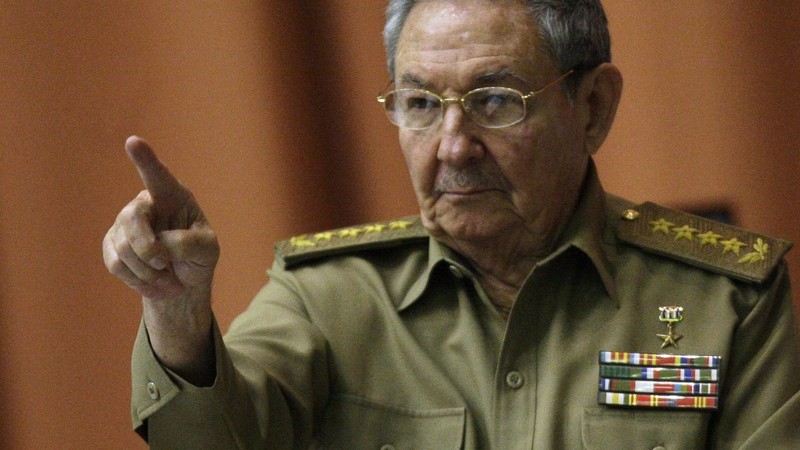
Speech delivered by Army General Raúl Castro Ruz, first secretary of the Communist Party of Cuba Central Committee, during the Second Extraordinary Session of the National Assembly of the People’s Power Ninth Legislature, on the occasion of the proclamation of the Constitution of the Republic, in the Convention Center, April 10, 2019, Year 61 of the Revolution
(Council of State transcript / GI translation)
Compañero Esteban Lazo, President of the National Assembly;
Compañero Miguel Díaz-Canel, President of the Republic of Cuba; now President of the Councils of State and Ministers;
Compañeras and compañeros:
It is an exceptional privilege for me to deliver the central remarks in this session to proclaim the Constitution of the Republic. This is the second occasion on which I am fulfilling such a great responsibility.
Just over 43 years ago, the Comandante en Jefe of the Cuban Revolution, Fidel Castro Ruz, before departing abroad to complete an obligatory international commitment, asked me to take his place in the solemn ceremony, held on February 24, 1976, to proclaim the Constitution which today ends its validity.
The date chosen is not accidental, 150 years ago, on April 10, 1869, the Mambises gathered in a Constituent Assembly, in Guáimaro, and agreed to our first Constitution, the product of the unity and institutionality required by the nascent Republic in Arms.
Freedom and independence from Spanish colonialism were among its essential objectives, along with the recognition of equality among all Cubans, without exceptions or privileges.
The Constitution we proclaim today represents the continuity of this first one, as it preserves the unity of all Cubans and the independence and sovereignty of the homeland, as fundamental pillars of the nation.
The constitutions of Baraguá, Jimaguayú, and La Yaya, later proclaimed at different moments during the insurrectionary conflict, were a continuing expression of the revolutionary constitutional tradition in our history.
It is worth recalling that, despite the victorious Mambi struggle against Spanish colonialism, true national independence was not achieved, nor was the installation of the democratic, progressive republic to which Cuban patriots aspired. The victory was cut short by the intervention of U.S. imperialism, the danger of which our forefathers, José Martí first of all, had warned.
Under the U.S. military occupation, the 1901 Constitution of the Republic was approved, which included the imposed Platt Amendment that subordinated our sovereignty to U.S. interests.
As Fidel said in his Central Report to the First Party Congress in December of 1975, after the Cuban War of Independence, (I quote) “Formal independence was conceded May 20, of 1902, with U.S. Navy bases and the constitutional amendment imposed, which, among other things, gave the United States the right to intervene in Cuba. This way, Yankee neocolonialism was installed in our homeland.” (End of quote)
Let us not forget that this constitution entered into effect on orders from the U.S. Military Governor.
Later, the 1940 Constitution, which was the product of a complex historical process following the defeat of the Machado dictatorship, was able to reflect some of our people’s aspirations at that time.
The international conjuncture during which the Constituent Assembly for that Magna Carta took place, within the framework of the world struggle against fascism and the active participation of assembly members with progressive ideas, in particular Communists, made possible the approval of an advanced constitutional text, for its time, establishing new social and economic rights. It included precepts such as the rejection of all forms of discrimination based on race, skin color, or sex; the eight hour work day; and prohibitions on large landholdings.
As is known, many of these postulates were left as dead letter, in some cases, because there was no subsequent legislative development, and in other cases, because their implementation was not feasible within the framework of that bourgeois society.
The validity of the 1940 Constitution was interrupted by the coup orchestrated by Batista in 1952, and the establishment of some spurious constitutional statutes. This event became the catalyst for the revolutionary movement of the Centenary Generation, whose political program was synthesized in Fidel’s self-defense statement during his trial for the assaults on the Moncada and Carlos Manuel de Céspedes Garrisons, known as “History will absolve me.”
The triumph of the Revolution, January 1, 1959, rescued the 1940 constitutional postulates, that were adjusted to the circumstances of a true revolutionary process. One of the first measures adopted on the legal order, was the promulgation of the Fundamental Law on February 7, 1959, the constitutional base for the new challenges.
It could not have been done any other way: we would either be obliged to stop the revolutionary process to dedicate ourselves to producing a new Constitution, or do what was actually decided.
In terms of the institutional configuration, the most important change was the definition of the Council of Ministers as the highest legislative and executive body, with constituent authority. This was an imperative necessity, to be able to adopt future measures as quickly as this historical moment required.
Under this authority, rights recognized in the 1940 text were concretized, and at the same time, new rights emerged that reached the poorest.
In the first case, this meant enforcing what was established, and later, complementary laws abolishing large landholdings. Years went by and no one had taken charge of enforcing these complementary laws, until the Revolution, and Fidel, and just a few months after the victory, May 17, 1959, the Cuban Revolution’s Agrarian Reform was enacted in the heart of the Sierra Maestra.
The Revolution was the foundation of the law that gave land to campesisnos; that guaranteed free and universal access to education; that put public health at the service of citizens; that guaranteed the equality of all Cubans; that nationalized – with popular support – the huge properties held by foreign companies that exploited our compatriots.
In his Central Report to the First Party Congress, compañero Fidel said (I quote): “We need a socialist constitution now, given the characteristics of our new society, the social consciousness, the ideological convictions, and the aspirations of our people. A constitution that reflects the general laws of the society we are constructing, the profound economic, social, and political transformations launched by the Revolution, and the historic accomplishments achieved by our people. A constitution, that is, which consolidates what we are today and helps accomplish what we want to be tomorrow.” (End of quote)
The provisional period lasted until the proclamation of the Constitution of the Republic of 1976, the result of a broad popular consultation and referendum.
The Constitution of 1976 reaffirmed the socialist nature of the Revolution proclaimed by Fidel on April 16, 1961, established the rights won by the people through the revolutionary process, and created a system of government based on the authority of People’s Power bodies.
Agreements reached at the Fourth Party Congress, in 1991, along with the experience of the rectification of errors and negative tendencies process, the collapse of the socialist camp, and the need to perfect our situation given the circumstances reigning in our society, and new ones developing with the arrival of the Special Period, led to a partial reform of the Constitution in 1992.
Fundamentally, modifications were introduced in the economic system and the organization and functioning of People’s Power bodies. The direct election of deputies to the National Assembly and delegates to Provincial Assemblies of People’s Power by the people was established, and religious freedom was expanded.
Also transcendental was the Constitutional Reform of 2002, when the United States was increasing its threats against the Revolution. At the insistence of mass organizations, and with the people’s majority support, the irrevocable nature of our socialism, and our revolutionary political and social system, were established in the Constitution. Added along with this was the statement that economic, diplomatic, or political relations with any other state were never to be negotiated under aggression, threat, or coercion, on the part of a foreign power.
The Economic and Social Policy Guidelines of the Party and the Revolution, approved during the Sixth Party Congress, in April of 2011, and the agreements that emerged from the First Party Conference, in January of 2012, made clear the need to introduce changes on the constitutional order.
Consequently, in 2013, the Political Bureau approved the creation of a working group for this purpose.
The Seventh Congress, in April of 2016, reaffirmed the Sixth Congress agreements and advanced in the elaboration of programmatic documents on the Cuban Social and Economic Development Model, the implementation of which would, likewise, have constitutional implications.
During the studies we conducted, we came to the conclusion that more than a reform, a new constitution was required, one that would not be limited to updating the economic and social order, but would deepen the principles of our state structure, the extension of citizen rights and guarantees, and other relevant issues; thinking not only of the present, but, above all, the future of the nation.
On June 2, 2018, this Parliament approved the initiation of the Constitutional Reform process and, toward this end, created a Commission of 33 deputies to prepare the draft of the new Magna Carta. I consider it appropriate, in this solemn session, to note the meritorious work done by members of this commission and its four advisors, not only in the preparation of the initial text, but throughout the entire process.
The first version of the draft of the new Constitution was submitted to this Assembly for analysis, July 21-22, 2018, and after a broad debate, a new text was approved and it was decided to submit this document to a popular referendum.
As has been reported, some nine million people participated in more than 133,000 meetings. We can affirm that this was not mere assistance, but that consciously, responsibly, and with absolute freedom, everyone was able to express their opinions, which also contributed to raising citizens’ legal culture. There were more than 1,700,000 remarks made, from which some 783,000 proposals emerged.
With their participation, the people became a true constituency. It is enough to reiterate here that, as a result of the popular contribution, almost 60% of the draft’s articles were modified.
The work carried out by those in charge of collecting and processing the population’s opinions was commendable. Completed in record time, their contribution was decisive to the successes of this profoundly democratic process.
This past December, the National Assembly approved the new Constitution of the Republic, and in accordance with the established reform mechanism, agreed to submit it to a referendum, which was held on February 24, when our people provided more evidence of their commitment and support to the Revolution and socialism.
It is significant that the majority of Cubans who exercised the vote were members of generations born after the triumph of the Revolution, reflecting the strength and continuity of our principles.
The results of the referendum are unequivocal proof of this assertion. As has been reported, 90% of citizens with the right to vote went to the polls, and of these, 86.85% voted in favor, a figure that represents 78.3% of all compatriots with the right to vote, with which the new Constitution of the Republic was approved.
It is also relevant that 95.85% of ballots were valid and only 9% voted No. With regard to this last fact, we consider that this vote did not, in all cases, mean rejection of the general content of the new Constitution, but rather reflected opposition to specific topics.
Cuba demonstrated, once again, that via democratic mechanisms and exercising the right to self-determination, it is possible to strengthen our socialist system as a viable alternative, at a time when imperialist aggression is increasing, as it attempts to discredit progressive alternatives for social development.
The Constitution we proclaim today guarantees the continuity of the Revolution and the irrevocability of our socialism. It synthesizes the aspirations of all those who for more than 150 years have fought for a free, independent, sovereign Cuba, with social justice.
This law of laws is a product of its time. It reflects the historical circumstances of the construction of our society and legally establishes the changes that are taking place with a vision toward the future, with the supreme purpose of achieving an increasingly prosperous, sustainable, inclusive, and participatory socialism.
With this new text, the revolutionary state is institutionalized and strengthened, prepared to conduct its work, as required, transparently and in accordance with the law. If something in particular distinguishes the document, it is respect for the full dignity of women and men, and the equality of Cubans, without discrimination, and these are precisely the pillars on which this society is based.
The constitutional text is the product of the joint effort of those who had the privilege of accompanying Fidel in the revolutionary struggle and the “new pines,” who are gradually assuming responsibility for the nation. This Constitution is a legacy for new generations of Cubans.
It is not enough to proclaim it, it is necessary to put its precepts into practice. In this endeavor, it is the Assembly’s responsibility to undertake an intensive legislative effort to comply with the norms established in the Transitory Provisions of the Constitution, a task already entrusted to several working groups.
Today, once this proclamation ceremony is concluded, the full text of the Constitution will be published in the Official Gazette of the Republic, and as of that time enters into effect.
Among the immediate tasks that we must undertake, by constitutional mandate, is the approval of a new Electoral Law, the draft of which is being developed, with the purpose of presenting it to this Assembly for approval, during its next ordinary session.
Once the Electoral Law is in effect, the National Electoral Council must be elected by this Assembly and, in accordance with the Second Transitory Provision of the Constitution, within the next three months, the Assembly itself will elect its President, Vice President, and Secretary, other members of the Council of State, and the President and Vice President of the Republic.
Likewise, once the President of the Republic is elected, within three months, the new government will be submitted to the National Assembly, for approval, that is, this Parliament will designate the Prime Minister, First Deputy Prime Ministers, Secretary and other members of the Council of Ministers.
We will work to ensure that all these steps are taken before the end of the year.
Likewise, mandated at the beginning of 2020, are the election of provincial governors and vice-governors, and the designation of superintendents by municipal assemblies.
As expected, the historical enemies of the Revolution have attempted to cast doubt on the legitimacy of this broad constitutional exercise. But all the slanders evaporate in the face of the irrefutable, massive support of our noble people.
We have been warning of the aggressive actions unleashed by the U.S. government against the Latin American and Caribbean region. It does so in the name of the Monroe Doctrine, with an arrogant McCarthyist contempt for socialism, for the self-determination of peoples, and the sovereign rights of countries in the region.
On July 26, 2018, during the commemoration of the 65th anniversary of Moncada, and January 1, this year, to celebrate the 60th anniversary of the triumph of the Revolution, I warned of the adverse panorama that was developing and the resurgence of our enemies’ enthusiasm and rush to destroy the example of Cuba. On both occasions I reiterated the conviction that the empire’s siege was tightening around Venezuela, Nicaragua, and Cuba. The facts have confirmed that assessment.
The region that Martí called Our America has, in recent times, been able to strengthen regional independence, in a climate of peace, cooperation, and harmony among its member states.
With the precept of achieving unity within diversity, sustained progress was made towards integration, complementarity, and the agreement among all to solve the economic and social problems of our peoples.
Latin America and the Caribbean were declared a Zone of Peace and progress was also made in the goal of reaching a more respectful relationship with northern neighbors.
The scenario today is different. The current government of the United States, with its hegemonic ambitions for the region, poses the most urgent threat of the last five decades to the peace, security, and well-being of Latin America and the Caribbean.
In pursuit of establishing its domination, several coups were orchestrated over a number of years, in one case, a military one, and others of a parliamentary nature, to remove progressive Presidents from office, while the participation of leftist leaders in elections was prevented via media campaigns and malicious legal charges. Precisely, last Sunday, marked the end of the first year of compañero Inácio Lula da Silva’s unjust incarceration, whose freedom we demand.
Unfortunately, there are governments and political forces that irresponsibly join imperialism in this warlike escalation.
The relentless siege of the sister Bolivarian Republic of Venezuela, using methods of unconventional warfare and economic strangulation, is the main target of aggression, but, the threat concerns us all.
The Venezuelan government and the Chavista people are writing admirable chapters of resistance. On Bolivarian soil, being defined today is whether Latin American and Caribbean nations have the right to self-determination, if sovereign power rests with the people or with a foreign government, if it is acceptable for a powerful country to determine the rulers of an independent state, if the rules and principles governing the United Nations have real value or are dead letter, if the peoples of the region will remain passive before the imposition of a sovereign power in a sister nation or respond to repudiate the crime.
We reaffirm, from this Parliament, our firm solidarity and support to the Bolivarian Chavista Revolution, President Nicolás Maduro Moros, and his people’s civic-military union.
To the more than 20,000 Cuban collaborators, 61% of them women, who are fulfilling missions in Venezuela, I convey our deep appreciation for their commitment and consecration to the noble, deeply humanitarian task they perform in the service of families in this sister nation. (Applause)
The tone being used by the United States government against Cuba is increasingly threatening, while steps are being taken to impair bilateral relations.
Cuba is blamed for all evils, using lies in the worst style of Hitler’s propaganda. We will never abandon the duty to act in solidarity with Venezuela. We will not renounce any of our principles and will strongly reject any form of coercion.
The stepping up of the economic war, the strengthening of the blockade, and continued application of the Helms-Burton Law, pursue the old ambition to overthrow the Cuban Revolution through economic strangulation and hardship. This aspiration has already failed in the past and will fail again (Applause).
We have let the U.S. administration know, with the greatest clarity, firmness and serenity, through direct diplomatic channels and in a public manner, that Cuba is not afraid of threats and that our vocation for peace and understanding is accompanied by the unshakeable determination to defend the sovereign right of Cubans to decide the future of our nation, without foreign interference.
We defend socialism, a system reviled by the United States government, because we believe in social justice, in balanced, sustainable development , with a just distribution of wealth and guarantees of quality services for the entire population; we practice solidarity and reject selfishness, sharing not what we have left over, but even what we ourselves lack; we repudiate all forms of social discrimination and fight organized crime, drug trafficking, terrorism, trafficking in persons, and all forms of slavery; we defend the human rights of all citizens, not of exclusive, privileged segments; we believe in the people’s democracy and not in the political and undemocratic power of capital; we seek to promote the prosperity of the homeland, in harmony with nature and caring for the resources on which life on the planet depends; and because we are convinced that a better world is possible.
We hope that the international community responds to this dangerous situation with consciousness and a sense of duty, and that we are not lamenting the outcome when it is too late.
Faced with the turbulent scenario that has taken shape, we have defined as imperative priorities preparing the country for defense, and the national economy’s development, both of equal importance.
As our population has noted, a series of measures have been underway for months in order to reinforce the combat capacity and readiness of the Revolutionary Armed Forces and the country’s entire defense system, under the strategic conception of the war of all the people, as established in the Constitution of the Republic we have just proclaimed.
At the same time, a group of decisions has been adopted to guide the performance of our economy, to resist and overcome new obstacles imposed by the tightening of the economic and financial blockade, without renouncing development programs that are underway.
Thus, we must remain alert and aware that we could face additional difficulties and that the situation could worsen in coming months. It is not a question of returning to the most difficult times of the Special Period in the 1990s. The current panorama is different, with the diversification of the economy, but we must always prepare for the worst variant.
It is imperative that efforts be redoubled to increase national production, especially food; review all expenses to avoid those that are not absolutely necessary; ensure more efficient use of energy resources, especially gasoline, which includes ending existing theft and assuming conservation as a firm guideline for leaders, from the national level to the local, and among compatriots in general.
Over 60 years, facing aggression and threats, Cubans have shown the iron will to resist and overcome the most difficult circumstances. Despite its immense power, imperialism does not possess the capacity to break the dignity of a united people, proud of its history and of the freedom conquered with so much sacrifice. Cuba has already shown that, yes, we could, yes, we can, and will always be able to resist, fight, and emerge victorious. (Applause). There is no other alternative.
That’s all for now.
Thank you very much.
(Ovation).